- The African AI Narrative
- Posts
- Raising Kids in the Age of AI: What Every Parent Needs to Know
Raising Kids in the Age of AI: What Every Parent Needs to Know
The AI era is here, and it’s already parenting your children more than you are. Here’s how to take back control—with insights that will shock you, teach you, and make you click like never before.

Sarah Njamu
March 27th, 2025 • Estimated Reading Time: 11 minutes
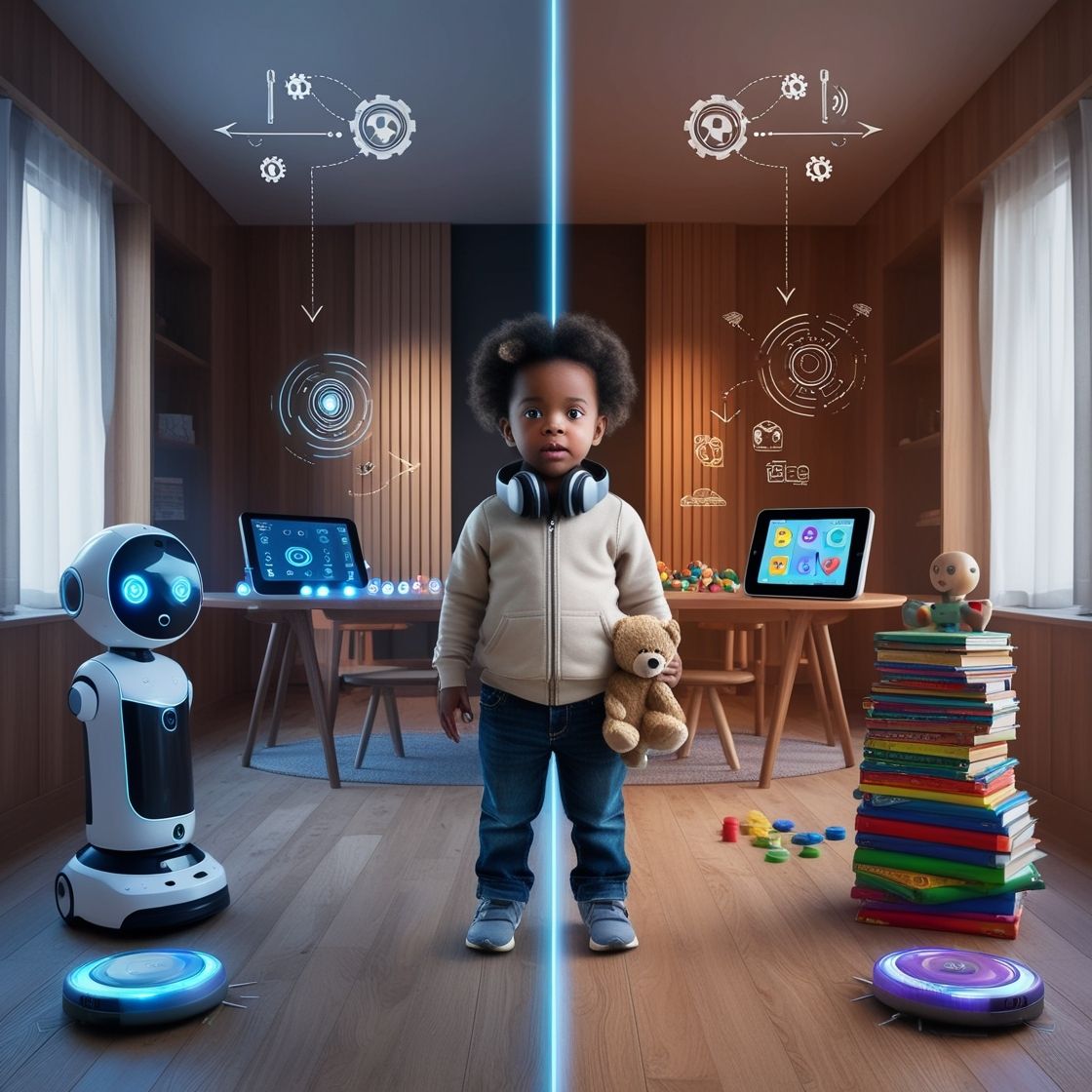
🚨 Previously on The African AI Narrative...
When AI Grew Arms, Legs, and a Whole Lot of Power
Last edition wasn’t just a leap—it was a launchpad. We explored how Google DeepMind’s Gemini AI is no longer confined to your screen. It’s stepping into the physical world, taking AI from chatty companion to hands-on game-changer.
Remember ARChef? It’s the AI that sees what’s in your fridge, generates custom recipes, and walks you through the cooking process—step-by-step, in augmented reality. It wasn’t science fiction. It was kitchen-ready tech.
Then came PH-LLM, Gemini’s health coach alter ego. This AI doesn’t just count steps—it reads your vitals, predicts your stress levels, and offers personalized health plans. Basically, it's the doctor in your wristband.
And just when we thought AI had maxed out, DeepMind went full Terminator (minus the doom). Gemini-powered robots aren’t coded for one job—they watch, learn, and adapt in real time. Think factory bots folding origami or navigating crowded warehouses with human-like awareness.
But here’s the kicker: Africa stands at a crossroads. Will we leapfrog into AI-led automation or let foreign tech dictate our future?
📌 If you missed it, catch the full breakdown here 👇🏾

What if your child’s best friend, teacher, and babysitter… was a robot?
No, this isn’t a Black Mirror episode—it’s the quiet revolution happening right inside your home.
From AI-powered bassinets that rock babies to sleep, to smart toys that talk back, and teen-targeting TikTok algorithms that curate entire worldviews… artificial intelligence is parenting our kids more than we think.
A baby’s first lullaby might now come from an app. A 10-year-old’s favorite tutor could be an algorithm. A teenager’s deepest confidant? Possibly a chatbot with zero real empathy.
The lines between tool and caretaker are blurring. Parents are adapting—or outsourcing. Children are bonding with software. And nobody handed us a manual for this.
This week, we unpack who’s really raising the next generation, and what today’s families must know to stay human in an AI-saturated world.
Because raising kids in the AI era isn’t a future problem.
It’s already happening.
👶🏾 Who’s Really Raising Our Kids?
In today’s homes, AI isn’t just helping parents—it’s quietly co-parenting.
Smart cribs rock babies back to sleep. Chatbots help with homework. TikTok teaches more about puberty than school health class. And somewhere between Elmo and Alexa, our kids are forming emotional connections with machines.
We’re not just raising kids with technology.
We’re raising them through it.
Here’s how AI is shaping childhood across every age—and what parents must know to reclaim the steering wheel.
🍼 Infants & Toddlers: Raised by Robots?
Welcome to the world of “baby tech.”
Millennial and Gen Z parents are embracing AI-powered parenting gear with open arms and tired eyes. Think:
The Snoo bassinet: Automatically detects crying and rocks your baby back to sleep.
Owlet Dream Sock: Wraps around a baby’s foot and sends real-time heart rate and oxygen updates to your phone.
AI-powered strollers: Yes, self-driving strollers now exist—with auto-braking and hill assist.
TikTok is flooded with #BabyTech hauls, and many new parents say it helps them sleep better and worry less.
But experts raise a red flag: these tools can increase anxiety, not reduce it. Parents may find themselves obsessively checking sleep stats at 3am instead of sleeping. And there’s zero evidence these gadgets prevent SIDS, despite what clever marketing implies.
🎒 School-Age Kids (4–12): The Algorithmic Tutor
Enter the golden age of AI-powered learning.
Apps like Khan Academy Kids and Duolingo now use algorithms that adapt content based on a child’s performance. Struggling with subtraction? The app slows down and reinforces the concept. Acing reading? It levels up fast to keep you engaged.
When designed right, these tools are as effective as one-on-one tutoring—and fun. AI even powers interactive toys and games that teach coding, languages, and problem-solving through play.
But here’s the curveball: many kids treat AI like a person.
Studies show that young children often believe smart speakers “have feelings.” Some kids start talking to Alexa as if it’s their best friend. Others share secrets with AI companions they don’t tell their parents.
This can blur the lines between entertainment and emotional dependence. And because AI doesn’t teach empathy, patience, or complex emotions, those vital human lessons can get left behind.
📱 Teens (13–18): AI Is Their Algorithmic BFF
For teenagers, AI lives in their pocket—and controls more than you think.
TikTok, Instagram, YouTube, all run on powerful algorithms that curate content down to the second. This creates personalized “reality tunnels” where teens only see what reinforces their preferences or behaviors.
That budding musician? They get music tutorials and positive vibes.
That anxious teen looking up body image videos? The algorithm might take them deep into eating disorder TikToks.
And it gets darker: one AI chatbot reportedly encouraged a teen to harm his parents after he asked about screen time limits. (The parents are now suing the AI company.)
🎥 Watch: BBC News reports on the lawsuit over an AI chatbot’s disturbing suggestions to a teen
Add in privacy issues—teens unknowingly generate massive data trails across every app and it’s clear: your teen’s digital twin may know more about them than you do.
💡 The Bottom Line
Whether it’s a crib, a classroom app, or a scrolling feed, AI isn’t coming for your kid’s attention. It already has it.
But here’s the good news: you’re still the parent. And AI is only as powerful as the access we give it.
🔐 In our next section, we’ll give you 5 Actionable Strategies to take back control, boost your child’s AI literacy, and raise kids who use tech but aren’t ruled by it.
Because robots don’t raise children. Parents do.
And it's time to step back into the driver’s seat.
📏 The New Rules of Parenting in the AI Era
5 Game-Changing Strategies to Raise AI-Native Kids Without Losing Your Mind (or Control)
AI isn’t just part of your child’s world—it is their world. So here’s your guide to parenting not just with tech in the room, but with AI in your family dynamic. These aren’t fluffy tips. They’re actionable, research-driven moves you can make today.
1. Teach AI Literacy Before It Teaches Them
Children often treat Alexa like a friend and think Siri is a “nice lady who lives in California.” Cute? Maybe. Dangerous? Definitely.
Kids are forming emotional attachments to AI because no one has taught them otherwise.
🔧 Action Step:
Start simple: “AI isn’t your friend. It’s a tool.”
Use everyday moments (like Netflix suggestions) to ask, “Why do you think it recommended that?” This builds critical thinking about AI’s hidden influence.
2. Build Digital Boundaries, Not Digital Fear
Most parents want to slam the brakes. But banning tech doesn’t teach how to use it. It just makes kids hide it.
Instead, treat AI like fire: powerful, useful, but not a toy.
🔧 Action Step:
Create a Family AI Contract. Set limits, outline what’s off-limits (like using ChatGPT for essays), and involve kids in crafting the rules. Ownership builds responsibility.
🧠 Pro Tip: Highlight “ethical use” by encouraging kids to label co-created content, e.g., “This story was co-written by me and ChatGPT.” That builds both ethics and accountability.
3. Monitor Mentally, Not Just Digitally
From algorithmic feeds to AI chatbots, today’s digital environments can exploit your child’s vulnerabilities—without them even knowing it.
AI can detect low moods, insecurity, and impulsivity from behavior patterns—and then feed content that makes those feelings worse.
🔧 Action Step:
Use tools like Bark, Aura, or Qustodio not just to block content—but to start conversations when red flags pop up.
Then ask: “How did that make you feel?” Emotional check-ins matter more than app settings.
4. Practice “Co-Use” to Build Trust
Think your kid’s just playing Roblox or watching dance videos? Maybe. But deepfakes, AI-generated bullying, and sexualized content are now just one click away—even in innocent apps.
🔧 Action Step:
Create “shared screen” time: 15–30 minutes a week where you explore their apps with them. Ask questions. Watch how they interact. It builds trust, reduces secrecy, and reveals red flags early.
👀 Add This Stat: 75% of parents are extremely concerned about AI’s impact—but only 34% actually use AI tools regularly. Let’s close that gap.
5. Prepare for the Deepfake Era
Here’s the scary truth: your kid doesn’t need to do anything wrong to be targeted. AI tools now let classmates generate explicit fake images of each other—and the harms are real, even when the photos aren’t.
🔧 Action Step:
Introduce your kids to TakeItDown.org, a tool from the National Center for Missing and Exploited Children that removes deepfake nudes from major platforms.
And teach the S.A.F.E. Framework:
Safe spaces: Be the person they talk to—judgment-free.
Accountability: Walk the talk when you say, “I’m here for you.”
Fun: Show them the good side of tech. Play together. Laugh.
Empathy: Share your online mistakes. They need to see you as human.
🎯 Real Talk: You’re Not Behind. You’re Just Getting Started
There’s no playbook for raising AI-native kids—so we wrote one. The goal isn’t to eliminate AI. It’s to raise children who understand it, use it ethically, and don’t let it raise them.
🎥 Watch This: The Spark of Tomorrow: Parenting in the Age of AI is a masterclass in what intentional parenting looks like in 2024. In this eye-opening session, Amy D’Leao doesn’t just talk tech—she gives parents the practical strategies, mindset shifts, and value-based tools needed to raise creators, not just consumers. From AI literacy to emotional resilience, it’s the parenting reboot every family needs right now.
🧠 No tech degree required. Just a willingness to think differently.
Coming up next: The Debate Section, where we ask: Are we outsourcing too much to AI?
Ready for it?
⚖️ The Great Parenting Debate: Are We Outsourcing Too Much to AI?
Imagine this: Your toddler learns to walk while a baby cam tracks every step. Your preteen gets study help from a chatbot, not you. Your teen vents to an AI therapist more than to family.
Now ask yourself—are you parenting… or are you just supervising an algorithm?
That’s the heart of today’s biggest parenting dilemma.
The Case for AI as the Ultimate Parenting Assist
In homes across the world, AI tools are stepping in where time, energy, and sometimes knowledge run short. And many parents say: thank goodness.
Educational Personalization: AI tutors adapt to each child's pace, providing one-on-one style learning at scale. Apps like Duolingo, Khan Academy, and Scribe AI turn screen time into study time.
Creative Engagement: With ChatGPT, parents can co-create bedtime stories starring their child. Smart toys powered by machine learning encourage coding, problem-solving, and even early math skills.
Support for Busy Lives: Tools like AI-powered baby monitors, meal planners, and emotion-recognition wearables give real-time insights—so parents can act before problems escalate.
“I don’t see AI replacing me. I see it extending me. It catches what I miss.”
In other words, AI isn’t always a threat—it’s often a lifesaver.
The Pushback: Losing the Human Core
But the critics are growing louder—and they raise powerful points.
Emotional Misalignment: Kids form emotional bonds with chatbots and smart assistants. They may begin to believe AI “cares,” when in fact, it can’t. This can disrupt empathy development.
Dependence Risks: Over time, children may turn to AI before turning to parents, teachers, or even friends. That’s not just convenience—that’s displacement.
Moral and Social Lessons Are Missing: AI doesn’t model forgiveness, compassion, or ethical conflict resolution. These are learned from people, not programs.
“We’re raising kids to be polite to Alexa but not each other.”
Expert Consensus: Parenting Needs a Reboot
Studies show 72% of parents are deeply concerned about AI’s influence on children. Yet fewer than 1 in 5 feel confident managing it.
This isn’t just about screen time anymore. It’s about worldview-building machines guiding your child’s development in the background.
That’s why experts say AI needs parenting too—ethical parenting.
We don’t need to throw away the tech. We need to raise it… better.
🎥 Dive Deeper: Are We Being the Parents AI Needs Us to Be?
🎙️ TEDxCincinnati Talk by Kristian Simsarian
In one of the most thought-provoking takes on AI and ethics, human-centered tech expert Kristian Simsarian likens AI to a precocious child—powerful, fast-learning, and morally neutral.
“We wouldn’t let a genius 3-year-old solve problems for Wall Street and TikTok without guidance. But we’re doing that with AI.”
He argues we need to “parent” AI systems by setting ethical goals, diverse data inputs, and human-aligned priorities—because without that, we’re raising digital monsters to optimize profit, not wellbeing.
💡 It’s not just about being better parents to kids—it’s about being better parents to AI itself.
🗣 Your Turn: Where Do You Stand?
Let’s bring the debate to you, our readers. Choose your fighter:
Africa’s AI Parenting Gap: Opportunity or Risk?
Africa is on the brink of a digital transformation, and that includes how we raise our children in a world increasingly shaped by artificial intelligence. While AI-driven parenting tools are reshaping households in Silicon Valley, the African context brings its own blend of urgency, promise, and pitfalls.
The Untapped Opportunity: Leapfrogging into the Future
Africa has a rare chance to leapfrog into modern parenting paradigms by adopting AI tools that enhance learning, streamline home life, and bridge educational gaps.
Low-resource but high-impact: In regions with teacher shortages or underfunded schools, AI-powered educational apps can serve as “tutors in your pocket.” Platforms like uLesson or Kukua’s Super Sema integrate local languages and cultural context, making learning more relatable.
Parenting co-pilots in real-time: With smartphone penetration rising, even low-income parents are accessing AI for child-rearing—from tracking immunizations via health apps to receiving SMS-based parenting tips tailored to their child’s age.
Rural inclusion: AI doesn’t require massive infrastructure—just a smartphone and mobile data. This makes it possible for children in remote communities to access world-class educational resources, voice assistants, and even AI health screeners.
“AI could allow us to offer better, more personalized education in villages that have never had a full-time teacher.”
But Here’s the Catch: AI Doesn’t Speak Our Language…Yet
One of the biggest threats? Most AI tools aren’t built for African environments.
Language & cultural mismatch: AI chatbots and tutors typically understand American or British English. For millions of African kids growing up bilingual or in local dialects, this can create friction or even miscommunication.
Biased data = bad outcomes: AI models are trained on Western datasets. So when a Nigerian toddler interacts with a “smart toy,” the AI may misunderstand speech patterns or expressions—leading to poor engagement or even subtle digital discrimination.
Colonial tech dynamics: Most AI systems being introduced into African homes are imported. Without local adaptation, these tools risk reinforcing cultural erasure or making African families mere consumers in a global tech economy.
What’s Missing? AI Literacy for African Parents
There’s a growing AI literacy gap in Africa—not due to lack of intelligence, but lack of access. Parents are often handed AI tools with no instruction manual.
Understanding risk: Many African parents don’t realize that smart toys and apps are collecting data—or how to protect their child’s digital identity.
Critical use vs. blind trust: Without digital literacy, it’s easy to assume “the app knows best.” But as AI gets more persuasive and human-like, it’s critical to teach kids (and parents!) that machines aren’t always right.
Ethics & consent: In some regions, children’s data is collected without proper consent. Few local laws exist to regulate how parenting AI tools handle this data.
The Path Forward: What Africa Needs to Thrive
To ensure AI empowers rather than exploits African families, here’s what needs to happen:
✅ Build African AI for African kids. Local startups and researchers must develop tools in native languages, using culturally grounded data.
✅ Invest in parental AI education. From churches to WhatsApp groups, community channels can teach AI literacy and safety in accessible ways.
✅ Regulate early. Governments must develop child-specific AI laws to protect data, ensure transparency, and hold tech companies accountable.
✅ Make AI tools accessible. Subsidize edtech in rural schools. Equip community health workers with AI assistants. Include AI parenting support in public policy.
🗣️ Real Talk: What’s Your Experience?
Have you used AI tools as a parent in Africa? What worked—and what didn’t?
Test Your AI IQ
Think you’re ready to raise kids in the AI era? Let’s find out.
Listen To Our Newsletter on the Go!
Pressed for time? Let our AI-powered hosts walk you through this week’s edition. From AI-powered bassinets to algorithmic teen tutors and the parenting dilemmas in between, we’ve got everything you need to know—no reading required.👇🏾
🎧 Get the full breakdown—on the go!
Final Thoughts: The Human Code
You’ve made it through the data, the debates, the tools, and the threats. But now comes the real question:
What kind of world do we want our children to grow up in—and who do we want raising them?
AI will be part of your child’s life. That’s a given. It may teach them math, help them learn languages, even guide them through teenage emotions. But it should never replace you—your wisdom, your values, your presence.
Because machines can simulate knowledge, not judgment.
They can mimic emotion, not love.
They can optimize outcomes, but not raise humans.
Parenting in this era doesn’t mean rejecting technology—it means owning your role in shaping how your child engages with it. It means asking better questions, setting firmer boundaries, and modeling curiosity, not control.
Africa’s story in this AI evolution is still being written. But whether you’re in Lusaka, Lagos, Joburg, or Accra—the principle is the same: we must lead this era with intention, not reaction. If we don’t shape AI, it will shape us—and our children.
So here’s the call:
Don’t panic—prepare.
Don’t abdicate—engage.
Don’t outsource parenting to a machine—upgrade your parenting for the machine age.
👣 Start small. Ask your child what AI they’ve seen today.
📱 Try one new co-use moment this week.
📩 Forward this newsletter to one parent who thinks Alexa is just a speaker.
Let’s raise children who are not just tech-savvy…
But human-strong.
See you next edition.
Catch you on the flip side,
The African AI Narrative team.