- The African AI Narrative
- Posts
- Africa’s First AI Factory Is Here - And It Changes Everything
Africa’s First AI Factory Is Here - And It Changes Everything
Strive Masiyiwa’s bold new AI venture with NVIDIA is more than just big news—it’s a whole new era for the continent.

Sarah Njamu
April 03, 2025
🚨 Previously on The African AI Narrative…
When AI Stepped In as Co-Parent
In our last edition, we didn’t just talk parenting—we dismantled the myth that raising children in the AI age is still a human-only job.
From smart cribs that rock your baby back to sleep to TikTok algorithms shaping teen identity, we revealed how artificial intelligence is no longer a tool in the background—it’s now part of the family dynamic. Some AI tutors are more patient than real ones. Some chatbots are listening better than parents. The quiet shift? AI isn’t raising your kids with you. It’s raising them for you.
We explored:
The growing emotional dependence kids have on smart assistants
The psychological impact of AI on empathy, boundaries, and identity
And the deepfake danger zone no parent can afford to ignore
Then we handed you 5 no-fluff strategies to take back control—because if you’re not actively parenting AI, it’s already parenting your child.
🛠 One quick win: Start building AI literacy early. Teach your kids to ask: “Why did this app recommend that?” This one question turns them from passive users into critical thinkers—and gives you a window into how AI is shaping their world.
📌 Missed the full breakdown? Catch up below 👇🏾

🚨 Up Next: We’re turning the lens from the living room to the data centre—because the biggest parenting shift may pale in comparison to Africa’s boldest AI move yet.
🔬 Demystifying AI Factories: The New Industrial Revolution
Picture this.
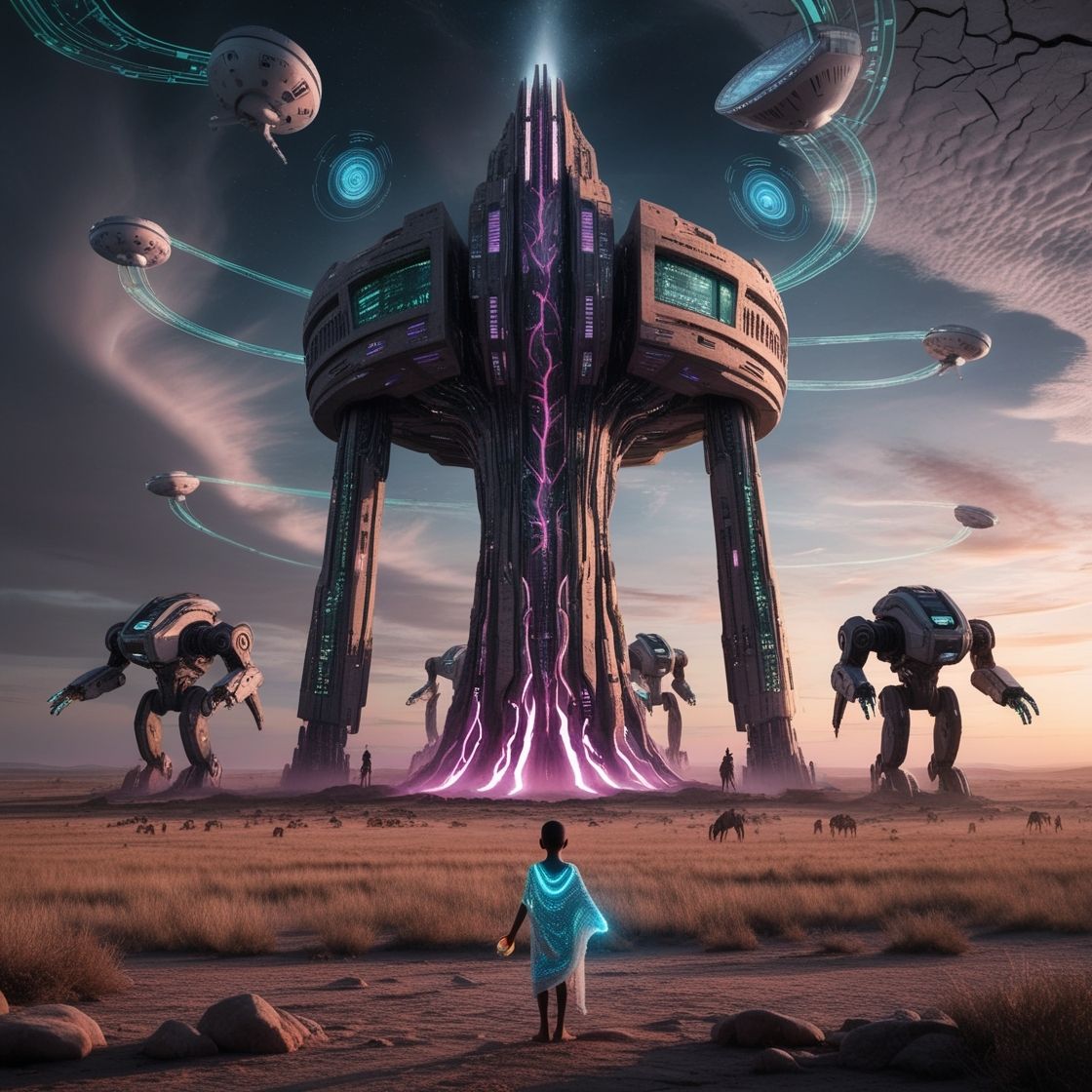
A vast building hums in the heat of the African sun. But instead of conveyor belts or welding arms, it houses machines that don’t build things—they build thinking. Inside, walls of supercomputers train AI models that can predict crop diseases before they happen, help doctors spot health issues sooner, and teach children in their local languages using nothing but a smartphone.
Welcome to the AI factory.
This isn’t science fiction. It’s the new frontier of industry—and Africa is officially stepping into it.
🏗️ So… what is an AI factory?
Let’s break it down: just like traditional factories turn raw materials into finished goods—iron into cars, cotton into shirts—AI factories turn raw data into intelligence.
📽️ Prefer to see it in action?
Watch this 30-second explainer from Dell and NVIDIA, where they unpack how AI factories transform data into intelligence—at speed, at scale, and across every industry imaginable. 👇🏾
These aren’t smokestack buildings. They’re data centres, fitted with superpowered chips (like NVIDIA’s GPUs) that crunch mind-boggling amounts of information to train and run AI models.
Inside an AI factory, four things are happening 24/7:
🧹 Data Pipelines: Raw data is gathered, cleaned, and prepped. This is like sorting and washing your vegetables before cooking—bad data means bad AI.
⚙️ Compute Power: Machines equipped with GPU supercomputers process the data. Think of this as the oven that “cooks” the intelligence.
🧠 Model Training: AI models are built, tested, and fine-tuned to do smart things—like detect fraud, optimize logistics, or translate between languages.
🤖 Orchestration: Software tools coordinate all of this like a conductor with an orchestra, ensuring everything runs smoothly and at scale.
When done right, it’s a factory for thinking tools. And you use them daily—whether you know it or not.
🧭 Why does this matter for Africa?
Because until now, we’ve mostly used AI tools built elsewhere—by people who don’t speak our languages, don’t understand our local problems, and don’t store our data on our soil.
That’s a problem.
As Strive Masiyiwa said:
“If Africa does not have direct access to compute—the power to train and run AI—we’ll be left out in the cold in the Fourth Industrial Revolution.”
Think about it:
Can we really trust AI tools to serve African farmers if they’re trained on farmland in Canada?
Can a Swahili-speaking chatbot help kids if the model doesn’t even recognize the language?
Can African hospitals safely use AI diagnostics if the patient data is being sent to a server in Frankfurt?
AI factories flip the script.
They bring the entire process—data, compute, model training—home. That means:
Better results for local problems
Greater control over our data
Faster innovation built by Africans, for Africans
🛠️ Real-World Example: How an AI Factory Can Help
Let’s say a Nigerian startup wants to build an AI that predicts malaria outbreaks based on weather and mosquito density. They’ve got the data—but to train the AI model, they need massive computing power.
Before? They’d have to rent time on a server in Europe or the US, paying in dollars, waiting on slow connections, and possibly violating data privacy rules.
Now? They upload their data to a supercomputer inside Africa, train the model locally, and deploy a real-time solution within days—at a fraction of the cost, and without compromising their data.
That’s the power of an AI factory.
💡 Actionable Strategy for Readers:
Leverage Local Compute
If you’re a startup founder, developer, or data scientist in Africa, start looking into compute credits or AIaaS (AI-as-a-Service) offerings from platforms like Cassava. As AI factories go live, this access will be gold—especially for training large models or building tools with local relevance.
📰 Breaking News: Africa Just Launched Its First AI Factory
This isn’t just a milestone. It’s a digital moon landing for Africa.
In a move that has the global tech industry doing a double-take, Zimbabwean telecoms mogul Strive Masiyiwa and NVIDIA, the world’s leading AI chipmaker, have teamed up to launch Africa’s first AI Factory - starting in South Africa and expanding across the continent.
This isn’t just another data centre upgrade. This is an AI super hub- a purpose-built infrastructure stacked with NVIDIA’s most advanced GPU supercomputers. It’s designed to bring compute power home to Africa, allowing governments, startups, researchers, and businesses to train and deploy AI models right here, on African soil.
📍 Where’s it happening?
Cassava Technologies, Masiyiwa’s digital infrastructure company, is kicking things off in Johannesburg. By June 2025, the first facility will go live with full AI-as-a-Service capabilities. The plan is to scale into Egypt, Kenya, Morocco, and Nigeria by late 2026- creating a pan-African AI factory network, interconnected by Cassava’s 100,000-kilometre fibre backbone.
💡 This isn’t just cloud computing. It’s a continent-spanning, sovereign AI engine -optimised for local needs, local languages, and local control.
🎥 Want the Full Picture?
This is bigger than headlines. It's about shifting the global AI power map. To see how the world is reacting to this bold move—and what it means for African innovation—watch this short video summary that’s making waves across tech circles:
It’s less than 10 minutes and worth every second.
🧠 What makes this factory different?
It’s not just the scale. It’s the strategy:
Compute Sovereignty: No more outsourcing AI training to Europe or the US. Africa now has its own AI muscle—locally hosted, regionally priced.
Data Control: From medical diagnostics to agricultural AI, sensitive data can stay within national borders—boosting privacy and compliance.
Startup Power-Up: AI compute was once the biggest barrier for African startups. With AIaaS from Cassava, that barrier just crumbled.
Pan-African Expansion: This isn’t a one-city project. It’s a continental infrastructure shift, backed by billions in investment and global AI expertise.
🌍 Coming Up Next: We unpack what this move means for Africa’s tech ecosystem—and how it positions the continent in the global AI race.
What Africa’s AI Factory Means for the Continent - And the World
Africa didn’t just join the AI race.
It built its own track.
The launch of Africa’s first AI factory isn’t just a headline—it’s a historic turning point. For decades, Africa has been a consumer in the global tech chain. But now, with Cassava Technologies and NVIDIA building world-class AI infrastructure directly on the continent, Africa is stepping into a new role: producer, pioneer, powerhouse.
A Game-Changer for African Innovation
Until now, training advanced AI models in Africa was a bit like building a rocket with no launchpad. Startups couldn’t afford the compute. Universities lacked access to high-performance GPUs. Researchers had to send sensitive data overseas just to get results.
Now, that changes.
With AI supercomputers deployed across Africa, innovators can:
Train models using local languages and culturally relevant data
Develop medical diagnostics fine-tuned for African populations
Build precision farming tools that actually understand local soil and climate
Silas Adekunle, one of Africa’s leading robotics entrepreneurs, called this move “a watershed moment.” He’s not alone. Founders, researchers, and educators across the continent are already preparing to plug in and level up.
🔐 Sovereignty = Strategy
There’s power in where your data lives—and who controls it.
For years, African governments and companies have relied on overseas cloud platforms to process data. That meant higher latency, privacy risks, and less control. With AI factories on the continent, data can stay in Africa—protected by local laws, stored on local infrastructure, and used to build tools that reflect African realities, not foreign assumptions.
📍 Think about this:
Health records stay in-country when training AI diagnostics.
National security data isn’t routed through a server in California.
Financial institutions can innovate without exposing sensitive information to third-party platforms.
This is more than infrastructure. It’s digital independence.
💰 Economic Fire starter
An AI factory isn’t just a building. It’s a value chain incubator.
Startups get affordable access to AIaaS (AI-as-a-Service), removing one of their biggest cost barriers.
Universities can finally conduct cutting-edge research on African soil.
Industries from agriculture to energy to finance can adopt AI at scale, without needing billion-dollar budgets.
Expect to see:
More AI-powered businesses emerging across Nigeria, Kenya, Morocco, Egypt, and South Africa.
A spike in AI-focused job creation, from data engineers to ethics consultants.
Local investment momentum as VCs back founders building with homegrown compute.
Strive Masiyiwa believes this could unlock tens of thousands of new African startups—and a new generation of digital wealth.
🎥 Want to feel the human side of this revolution?
Watch this powerful, heartfelt breakdown by Professor Zeus—blending tech insight with personal narrative, and showing why this AI Factory is more than hardware.
It’s hope. It’s hustle. It’s homegrown innovation at scale.
🌐 Africa’s Place in the Global AI Power Map
Africa has just 0.1% of the world’s compute power. Until now.
The AI factory doesn’t just change what’s possible in Africa—it changes what’s possible for the world.
Expect:
New AI models that understand African languages, culture, and context
Partnerships between African researchers and global institutions
A rising competitive advantage as Africa leapfrogs legacy systems and builds for the future
Remember what mobile banking did for Africa?
This is the next leap—and it’s even bigger.
⚠️ Challenges? Yes. But the Vision Is Bigger.
Let’s be clear: this isn’t a magic bullet.
Africa still needs:
Massive upskilling in AI engineering and data science
Strong governance and AI regulation to ensure ethical use
Reliable energy infrastructure (Cassava is already investing in solar to help offset this)
But these are solvable. What’s not solvable is sitting on the sidelines of the Fourth Industrial Revolution.
This factory isn’t just about technology—it’s about rewriting the story of what’s possible when Africa builds for itself.
Expert Voices: What Africa’s Tech Leaders Are Saying
The launch of Africa’s first AI factory has sparked a tidal wave of commentary—from robotics innovators in Lagos to AI ethicists in Tunis. This isn’t just a press release moment—it’s a pulse-check on Africa’s rising AI ecosystem.
Here’s what the people on the ground are saying:
🇳🇬 Silas Adekunle, CEO of Awarri (Nigeria)
This is a watershed moment for Africa’s tech scene. We’re no longer just consumers of AI—we’re creators.
Adekunle, who’s pioneering voice-based AI models in African languages, emphasised how access to GPU compute could cut months off development time and costs for startups. With local access, training sophisticated models for rural agriculture, education, and health no longer requires dollar-burning cloud accounts in the U.S.
🇲🇦 Hassan Kharjouj, Digital Development Advisor (Morocco)
This isn’t just a tech play—it’s strategic. Morocco’s digital backbone is ready, and this gives us the competitive edge.
Kharjouj sees Morocco as a regional hub for AI innovation—and the factory as a gateway to develop sovereign solutions for everything from aerospace to cybersecurity.
🇿🇦 Professor Colin Thakur, Durban University of Technology (South Africa)
The cost of NVIDIA chips has made advanced AI research nearly impossible in African academia. This democratises that power.
Thakur, who mentors young AI researchers, noted that the new AI factory enables universities to finally compete at the cutting edge. Deep learning for medical imaging? Climate modeling? All now possible—without waiting on slow, expensive, overseas servers.
👁️ Zoom Out: Why These Voices Matter
These aren’t outsiders theorising from Silicon Valley.
These are the builders, educators, and strategists shaping the next decade of African tech. Their message is clear: the AI factory is a launchpad—but how high we fly depends on what we do next.
💭 What do you think?
📊 Coming up next: A breakdown of the rollout timeline, what countries are first, and how you can access the power of Africa’s AI factory. Want in? Let’s go.
Rollout & Access: When, Where & How to Plug Into Africa’s AI Power
So we’ve got the vision. We’ve heard from the experts. Now let’s talk rollout.
Strive Masiyiwa isn’t just dreaming—he’s building. And this rollout isn’t some far-off “someday.” It’s happening now.
📍 Phase 1: South Africa Goes First (June 2025)
The very first node in Africa’s AI factory network will go live by mid-2025 inside a Cassava Technologies data centre—most likely in Johannesburg or Cape Town. That site will house a high-performance NVIDIA GPU-powered supercomputer, offering AI-as-a-Service (AIaaS) to researchers, governments, startups, and businesses across the continent.
You won’t just be renting space—you’ll be accessing compute capacity that rivals Silicon Valley… from Soweto to Saldanha.
🌍 Phase 2: The Continental Grid (2026)
Once the South Africa hub is fully operational, the factory expands to four more countries:
🇪🇬 Egypt
🇰🇪 Kenya
🇲🇦 Morocco
🇳🇬 Nigeria
These are no random picks. Each has solid infrastructure, existing Cassava data centers, and a swelling base of AI builders hungry for local compute. The goal? A pan-African network of supercomputing hubs, stitched together by Cassava’s massive 100,000km fiber-optic backbone for lightning-fast access.
Think of it as Africa’s AI cloud—built in Africa, for Africa.
Access: Who Gets to Use It (And How)
This isn’t a VIP room for billion-dollar companies. Cassava is making it clear: the AI factory is for the continent.
Here’s who can plug in:
Startups & Founders: No more begging for compute credits abroad. Train and deploy models locally.
Researchers & Universities: Power cutting-edge experiments without shipping data overseas.
Governments & NGOs: Analyse national data, build predictive models, stay data-sovereign.
Tech Builders & Devs: Want to fine-tune a chatbot in Igbo or test a climate model? You’ve got the firepower now.
Cassava aims to offer AI-as-a-Service (think cloud access, usage-based billing), making it affordable and scalable. That means you can spin up compute power without massive upfront costs—just like AWS, but homegrown.
Energy, Sustainability & Reliability
But can it stay on?
South Africa’s rolling blackouts are no secret. Cassava knows it too. That’s why they’re investing in solar-powered energy infrastructure to keep the AI factory humming sustainably, even when the grid stumbles. A solar farm in the Free State province is already underway to power the Johannesburg cluster.
This isn’t just tech. It’s resilience.
Breaking AI News: Kenya’s $1B+ National AI Strategy Sets the Tone for Africa
While Africa’s AI Factory grabs global headlines, Kenya is quietly setting up the rules of the game. The country just unveiled its National AI Strategy 2025–2030—a visionary roadmap backed by a Ksh 152 billion (~$1.2B) budget, and it’s got serious range.
This strategy isn’t just about building models—it’s about sovereignty, innovation, and scale. Kenya wants to be the AI model innovation hub of Africa, and it's putting its money where its mouth is.
The plan is built around three pillars:
AI Digital Infrastructure to ensure compute access across the country,
A robust data ecosystem to feed local models with local context,
And a national push for homegrown research, innovation, and commercialization.
But the real flex? A nationwide pipeline to train talent, enforce ethical guardrails, and open the door for private and public-sector AI deployments in health, agriculture, education, and security.
This isn’t just a document—it’s a playbook.
Dive deeper here → citizen.digital's full breakdown
📄 Or grab the full Kenya AI Strategy 2025–2030 👇🏾
|

Test Your AI IQ
Think you’ve been paying attention? Let’s find out. This week’s quiz is all about Africa’s digital leap—from raw data to real-time intelligence.
Listen To Our Newsletter on the Go!
Pressed for time? Let our AI-powered hosts break it all down for you—no reading required. From Africa’s first AI factory and its rollout plans to startup breakthroughs and compute sovereignty, this audio edition delivers everything you need to know- straight to your ears.👇🏾
🎧 Get the full breakdown—on the go!
Final Thoughts: This Isn’t Just Infrastructure—It’s a Statement
Africa didn’t ask for a seat at the AI table.
It built its own.
From the dust of digital dependency, we’re now seeing the birth of compute sovereignty - built by Africans, powered by the world’s best chips, and designed to serve African problems, in African languages, using African data.
This AI factory isn’t just about machines that think. It’s about:
Farmers predicting their harvests with algorithms.
Doctors diagnosing with AI fine-tuned for African populations.
Startups training world-class models without begging Silicon Valley for credits.
It’s about flipping the script.
And yes, challenges remain—regulations, energy reliability, talent gaps. But if we’ve learned anything from this edition, it’s this:
🚫 The old excuse of “We don’t have the tools” just expired.
Africa has the tools now. The question is: What will we build with them?
So, whether you’re a startup founder, policymaker, student, or curious observer:
📍 Start learning.
🛠 Start building.
🔗 Start collaborating.
Because this isn’t a newsletter you just read.
It’s one you act on.
We’re witnessing a redefinition of African tech—and you’re right on time.
See you in the next edition. And until then…
Keep thinking bold.
Keep building local.
Keep moving forward.
Catch you on the flip side,
The African AI Narrative Team.